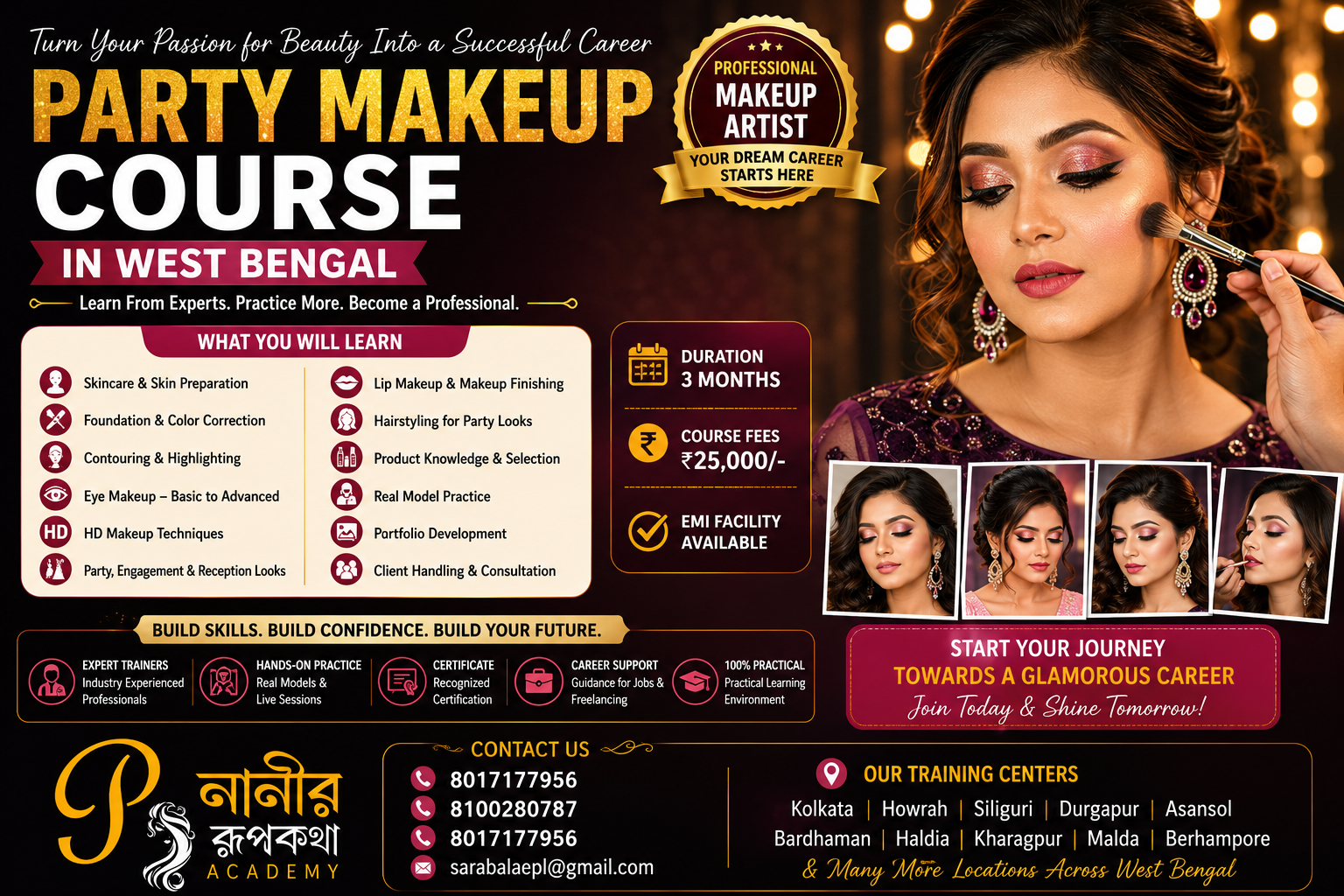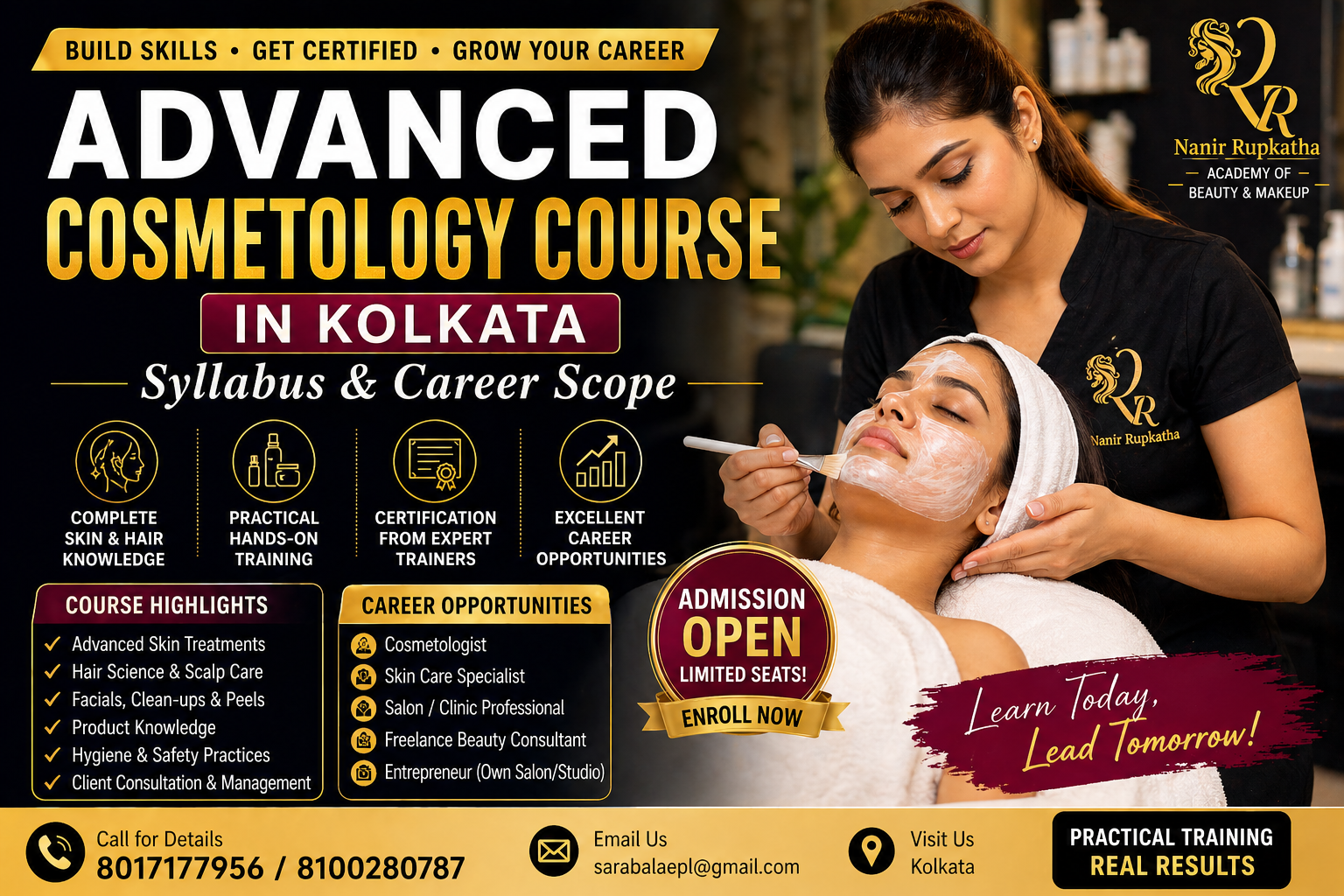
Nanir Rupkatha lists its Basic to Advance Makeup course at ₹25,000 and its Basic to Advance Bridal Makeup course at ₹75,000. These are published course fees. Before setting your budget, ask for the separate kit, registration and exam charges, along with the tax position. You can check the official makeup course and bridal makeup course pages.
A price alone leaves several questions open. How often will you attend? Will you apply makeup yourself in each practical class? And will you take the products home?
Use this guide to compare makeup course fees in Kolkata alongside duration, training hours and what you actually receive for your money.
Makeup Course Fees in Kolkata at a Glance
The comparison below covers published details for three courses. It does not represent a Kolkata-wide price range or rank the academies.
| Course | Published course fee | Published duration | Total training hours | Kit cost | Exam and certificate charges |
|---|---|---|---|---|---|
| Nanir Rupkatha: Basic to Advance Makeup | ₹25,000; confirm taxes and additional charges | 3 months on the course page; homepage says 4 months | Confirm with the institute | Confirm with the institute | Course page includes certification; confirm any separate exam charge |
| Nanir Rupkatha: Basic to Advance Bridal Makeup | ₹75,000; confirm taxes and additional charges | 6 months | Confirm with the institute | Confirm with the institute | Syllabus lists exams and a certificate day; confirm charges |
| A N John: Beginners Makeup Course | Confirm with the institute | 3 weeks | Confirm with the institute | Confirm with the institute | Confirm with the institute |
Nanir Rupkatha’s homepage and makeup course page give different durations. Ask the admissions team to confirm the schedule for your chosen batch in writing.
What Should Your Makeup Training Fee Cover?
Ask for a written breakdown under teaching, practice, products and assessment. This gives you a clearer comparison than a package name such as “professional” or “advanced”.
Classroom Teaching and Product Knowledge
Review how the trainer teaches product selection, skin preparation and shade matching. Ask them to explain the order of lessons, especially if you have never worked on another person’s face.
You need more than a shopping list. During a course enquiry, ask how the trainer will help you choose between products and correct a poor shade match.
Practical Makeup Training
Separate time spent watching a demonstration from time spent doing the work yourself. Ask how many complete looks you will create, whether you need to bring a model and how the trainer will review your work.
Here is a useful classroom question: “If my base looks patchy, will I get time to remove it, correct the mistake and try again?” The answer helps you understand the teaching approach.
Certification and Assessment
Check who issues the certificate, what you must complete to receive it and whether the course fee covers the first assessment. Ask separately about retests and replacement certificates.
For Nanir Rupkatha’s general makeup course, the page explicitly includes certification and portfolio building, which means creating a collection of photographs showing your skills. It does not give a separate exam price.
Makeup Course Duration in Kolkata: Count the Hours Too
Compare the weekly timetable before choosing between a short course and a course spread over several months. Calendar duration tells you when training ends. Total hours tell you how much scheduled learning the academy offers.
Ask for class dates, hours per class and the split between demonstrations, supervised practice and assessments. Exclude lunch breaks when you compare teaching time.
Short Courses
A N John lists a three-week Beginners Makeup Course on its classroom programmes page. That listing does not show a makeup fee or total hours. Do not use the neighbouring hairdressing course prices as makeup course fees.
If you prefer a short course, check whether the timetable leaves enough time for repeat practice. Also confirm the starting level. “Short” does not tell you whether a course suits a beginner or an experienced artist.
Basic to Advanced and Specialist Courses
Compare the modules with the work you want to learn. For bridal training, ask about a complete look, including hair, draping and finishing within a planned appointment time.
If a course advertises airbrush makeup, ask whether you will practise with the machine yourself. Airbrush makeup uses equipment to spray makeup onto the skin; watching the trainer use it does not tell you how much equipment practice you will receive.
Makeup Course Kit Cost: Find Out What You Keep
Treat access to classroom products and ownership of a personal kit as separate items. Ask the academy to state which arrangement applies before you buy anything.
Nanir Rupkatha’s makeup course and admission pages do not specify a kit price or item list. Kit cost: Confirm with the institute.
Use this checklist when you request an itemised kit quote:
- Foundation and base products, including the shades you will receive.
- Concealers and colour correctors.
- Face powders, blush and highlighter.
- Eye makeup and lip products.
- Brushes, sponges and other application tools.
- Skin-preparation products.
- Cleaning supplies and disposable applicators.
- A storage case or bag.
This is a purchase checklist, not a promised kit from any academy. Ask for product names, quantities and sizes, and check which items you already own before paying for duplicates.
Also ask who supplies replacement products if you use them up during practice. Include those purchases in your learning budget.
Tuition Fee vs the Total Cost of Learning Makeup
Calculate your total from the written quote:
Total learning cost = course fee + separately payable kit cost + registration charges + exam or certificate charges + other required expenses.
Add taxes only if the quote excludes them. Avoid counting an included certificate or kit twice.
Keep a second budget for travel to class, meals, home practice and any model or portfolio arrangements. If you travel across Kolkata, try the journey at your expected class time before committing to the batch.
How to Judge Whether a Higher Fee Offers More Value
Ask the academy to show what the extra money buys. Look for specific differences you can check:
- More supervised practice, with enough time to repeat difficult techniques.
- A clear class size and a named trainer for your batch.
- Detailed modules that match your intended work.
- Student portfolios showing work students completed themselves.
- A defined photography package, including the images you receive.
- Written details of any support after the course ends.
Review the trainer’s recent work and ask who will teach each module. If the academy shows a polished bridal photograph, find out whether it shows the trainer’s work, a student’s work or a jointly completed look.
For portfolio photography, ask how much editing the photographer applies. Request examples that let you assess the makeup clearly.
Choose according to these details. A higher fee alone gives you little evidence about the feedback you will receive in class.
Which Nanir Rupkatha Course Matches Your Goal?
Basic to Advance Makeup
The general makeup course lists day, evening, party and bridal techniques, product knowledge, skin-tone matching, HD and waterproof application, personal branding and client consultation. HD refers to high-definition camera work. Ask the trainer what that module involves in practice.
The page also mentions an EMI facility, meaning payment in instalments. Confirm the deposit, payment dates, total payable amount and any added charges before choosing that option.
Basic to Advance Bridal Makeup
The bridal makeup syllabus includes Bengali bridal looks, saree and lehenga draping, hairstyles, eye makeup, party and engagement looks, airbrush work and kalka practice, the decorative bridal forehead work. It also lists practice days, exams, portfolio work and salon management.
If you want to offer complete bridal looks, use this syllabus to ask how much individual practice each module receives. The list of topics does not tell you the hours per topic or the number of models you will work on.
Choose Training Around Your Experience and Budget
If You Are a Beginner
Look for lessons that start with tools, product selection and basic application. Ask whether the trainer checks your progress before moving to full bridal looks. Avoid buying an expensive kit before you understand the course requirements.
If You Are Changing Careers
Plan for class attendance and practice alongside your current responsibilities. Keep some money aside for the period after training, when you will need to build examples of your work and approach clients or employers.
If You Already Work in Beauty
Write down the skills you want to improve. Compare a focused module with the full course syllabus so you can judge whether repeating the foundation lessons serves your goal.
If You Have a Job or a Tight Budget
Set a spending limit that includes the full learning cost. Then compare payment dates and attendance requirements. Nanir Rupkatha’s admission form offers morning and afternoon preferences, but it does not confirm seat availability or exact class timings.
Can You Start a Makeup Career After Training?
Treat course completion as a point to assess your readiness. Before accepting independent bookings, practise complete looks, keep clear photographs and ask your trainer for feedback on both finish and timing.
Explore freelance party or bridal work, salon roles and studio work according to the skills you can demonstrate. If fashion or editorial makeup interests you, build examples for that type of assignment. For teaching, first develop your practical work and your ability to explain and correct mistakes.
Alongside makeup practice, work on client conversations, appointment planning, service pricing and keeping accurate booking records. Ask your trainer to cover product handling and hygiene procedures in practical classes.
Use social media to show your own work with permission from the person in the photograph. Judge your progress by the looks you can complete consistently, rather than expecting a course certificate to bring bookings on its own.
Questions to Settle Before You Pay
Keep the answers together in one message or document:
- What is the final payable amount, including taxes and compulsory extras?
- What are the batch dates, class timings and total teaching hours?
- How many practical looks will I complete, and who arranges models?
- What kit or classroom products will I receive, and what can I keep?
- Who issues the certificate, and what are the exam and retest terms?
- What does portfolio support include, and who pays for photography?
- What happens if I miss a class or the academy changes the timetable?
- What are the deposit, instalment, cancellation and refund terms?
Once you have those answers, use Nanir Rupkatha’s makeup course admission form or call the admissions number listed there, 8017177956, to discuss your course and batch preference.
Frequently Asked Questions
Can I choose a course only for personal makeup?
Tell the academy that you want to apply makeup on yourself. Ask whether it offers a separate self-makeup option and request that course’s fee and syllabus. Do not assume you need a full professional programme for this goal.
Does choosing a batch in the admission form reserve a seat?
Nanir Rupkatha’s form asks for your course choice and preferred batch. It does not explain a seat-reservation rule. Ask the admissions team what confirms your place and request written confirmation.
Can I speak to a former student before joining?
Ask the academy whether a former student is willing to discuss the course with you. Focus on feedback during practice, timetable reliability and expenses beyond the initial quote. Respect the student’s privacy if they decline.